Understand what is between your eye and the scene.
An optic is a system of lenses, mechanical adjustments, reticles or aiming references where applicable, coatings, housings, and design tradeoffs. Magnification is only one part of what determines whether an optic is useful.
Learn the optical system before comparing brands.
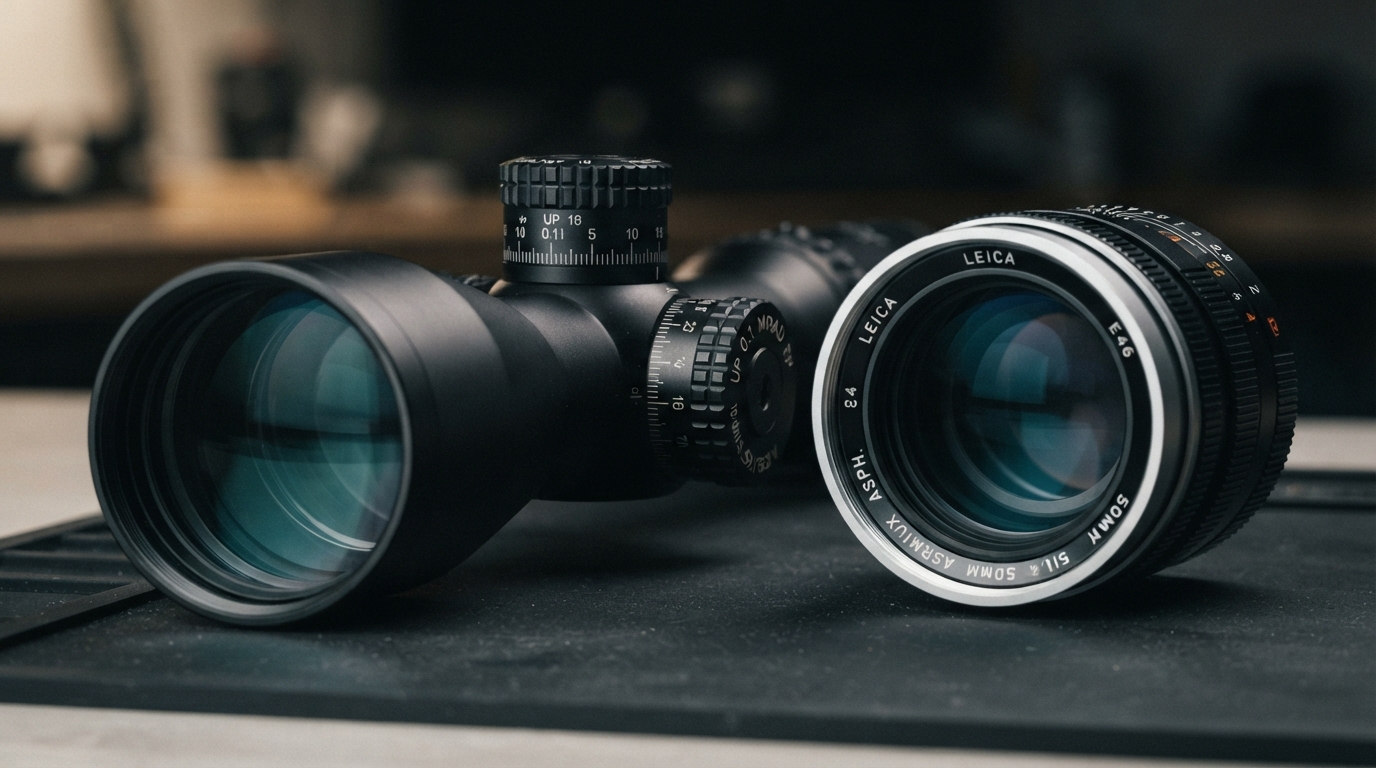
What makes an optic good?
A useful optic combines appropriate magnification, a usable field of view, suitable eye relief, clear glass, predictable adjustments, durable construction, and a design matched to the task.
No single specification determines optical quality. A strong optic is a system whose compromises make sense for how it will actually be used.
Magnification is only one part of the image.
Different optical systems solve different problems.
Designed around a simple sighting or reference image without significant optical magnification.
Provides one optical magnification level with fewer variable components.
Allows the user to change magnification within a designed range.
Two-eye observation optics designed around broader viewing and portability.
Higher-magnification observation optics designed for detailed viewing at longer distances.
Optics designed around observation or performance in challenging lighting conditions.
Learn the specifications in the order they affect the experience.
- 01→
Types of Optics
Understand the basic categories before comparing individual products.
- 02→
Magnification & Field of View
Learn why increased magnification often changes how much of the scene you can see.
- 03→
Eye Relief & Eye Box
Understand how easily the image can be acquired and maintained.
- 04→
Glass & Coatings
Learn what lenses and coatings contribute to image quality.
- 05→
Parallax & Adjustments
Understand what the adjustment systems are designed to change.
- 06→
Buying Your First Quality Optic
Turn specifications into a rational purchase framework.
More magnification means more apparent size—not automatically more useful detail.
Magnification makes objects appear larger, but increasing magnification can affect field of view, image stability, exit pupil, brightness perception, weight, size, and usability depending on the optical design.
Objective diameter is only part of light-gathering performance.
A larger objective can collect more light, but lens quality, coatings, magnification, exit pupil, optical design, and overall system efficiency also influence the image reaching the eye.
How much of the scene can you see at once?
Field of view describes the width of the scene visible through the optic at a given setting or distance. Increased magnification often narrows the visible area, though exact behavior depends on design.
Good glass is frustrating if you cannot easily see through it.
Eye relief and the eye box strongly influence how forgiving an optic feels during normal use.
The distance between the eyepiece and the viewer's eye where the full image can be seen.
The practical range of eye positions that still allow a useful full image.
These characteristics strongly influence how forgiving an optic feels during normal use.
Exit pupil connects magnification to the light reaching your eye.
Exit pupil describes the diameter of the beam of light leaving the eyepiece. It is commonly approximated by dividing objective diameter by magnification in simple optical systems.
40 mm objective ÷ 10× magnification = 4 mm exit pupil
The number is useful, but lens quality, coatings, optical design, and the observer's eye still matter.
What does parallax actually mean?
In practical optics discussions, parallax refers to apparent movement between the image and a reference point when the viewer's eye position changes under certain conditions. Some optical systems include adjustment mechanisms intended to reduce or correct this effect at selected distances.
A reticle should make information easier to use.
Reticles range from extremely simple visual references to more information-dense designs. Complexity is useful only when the additional information serves the task rather than obscuring the scene.
Simple Reticles
Minimal visual references that keep the scene uncluttered.
Illuminated Reticles
Add a powered reference for low-light visibility.
Etched Reticles
Reticles etched into the glass rather than projected.
First vs Second Focal Plane
A technology concept affecting how the reticle behaves with magnification.
First vs. second focal plane.
The reticle changes apparent size along with magnification because of its position within the optical system.
The reticle maintains a similar apparent size as magnification changes.
Each approach has design advantages and tradeoffs depending on how the optic is intended to be used.
“Good glass” is shorthand for several different things.
Lens material, surface quality, coatings, internal baffling, alignment, design, and manufacturing consistency all influence the final image.
Transmission
How effectively light passes through the optical system.
Contrast
The separation between light and dark areas in the image.
Color Rendition
How faithfully the optic reproduces the scene's colors.
Glare Control
Management of stray light that washes out the image.
Chromatic Aberration
Color fringing that can appear at image edges.
Coatings
Surface treatments that manage reflections and transmission.
Edge Performance
Image quality at the periphery, not only the center.
Marketing terms are less useful than the image they produce.
What do lens coatings do?
Optical coatings can be used to manage reflections, improve transmission across selected wavelengths, protect surfaces, and influence glare and contrast. The phrase “fully multi-coated” alone does not explain the quality of the coating design or application.
Sharpness at the center is not the whole image.
An optic should be evaluated across the useful field, not only by looking at the center of the image under perfect lighting.
Center Sharpness
Detail at the middle of the image, where it is usually strongest.
Edge Sharpness
Detail toward the periphery, which can fall off depending on design.
Distortion
How faithfully straight lines and geometry are preserved.
Chromatic Aberration
Color fringing that can appear, especially at the edges.
Glare
Stray light that reduces contrast and washes out the scene.
Color
How accurately the optic reproduces the scene's colors.
Contrast
The separation between light and dark in the image.
Low-Light Behavior
How the image holds up as available light decreases.
Adjustments should be repeatable, understandable, and appropriate to the optic.
Focus on mechanical design and usability rather than any specific application procedure.
Focus
Adjusts the optical path for a sharp image at the scene distance.
Diopter
Adjusts the eyepiece to the viewer's eye.
Parallax Adjustment
Corrects parallax at selected distances on compatible optics.
Magnification Ring
Changes power on variable-magnification optics.
Turrets / Adjustment Controls
Mechanical controls for reference alignment where applicable.
Illumination Control
Adjusts reticle illumination brightness on compatible optics.
Optical quality matters only while the optic stays aligned and functional.
Housing Material
The structural material and its strength-to-weight tradeoffs.
Sealing
Protection against dust, moisture, and internal fogging.
Weather Resistance
How the optic handles rain, humidity, and temperature swings.
Mechanical Alignment
Whether the optics and adjustments stay true over time and use.
Control Durability
How well controls and turrets hold up to repeated use.
Lens Protection
Coatings, caps, and design choices that protect glass surfaces.
Warranty
Manufacturer support when something goes wrong.
Service
Availability of repair, recalibration, or maintenance.
The image changes when the light disappears.
Low-light optical performance depends on more than objective size. Magnification, exit pupil, transmission, coatings, contrast, stray-light control, lens quality, and the observer's own vision all contribute.
Choose the optic around the viewing problem.
- 01
Define what you need to see
Distance, subject size, environment, movement, lighting, and observation time matter.
- 02
Choose the optic type
Start with the optical format rather than a brand.
- 03
Select practical magnification
Use enough magnification to solve the problem without accepting unnecessary size, weight, or field-of-view compromises.
- 04
Evaluate viewing comfort
Eye relief, eye box, focus, controls, and ergonomics matter during extended use.
- 05
Look at the complete image
Evaluate center detail, edge behavior, contrast, glare, color, and low-light performance.
- 06
Check mechanical quality
Controls, adjustment consistency, sealing, construction, support, and warranty matter.
- 07
Compare real alternatives
Compare products serving the same task and price range.
Review the image and the system around it.
An optics review should evaluate optical performance, controls, viewing comfort, mechanical construction, specifications, ergonomics, environmental behavior, tradeoffs, and realistic alternatives.
Optics testing is being added as equipment becomes available.
Until then, the Optics library focuses on the technology, evaluation criteria, and buying frameworks that future NSG reviews will use.
Represent an optics manufacturer or brand? NSG accepts appropriate products and loaner equipment for independent evaluation. Supplying equipment does not guarantee favorable coverage.
Some decisions make more sense side by side.
- →
Fixed vs Variable Magnification
Simplicity and strength versus flexibility and complexity.
- →
First vs Second Focal Plane
How reticle behavior changes with magnification.
- →
Red Dot vs Magnified Optic
Speed and simplicity versus reach and detail.
- →
Binoculars vs Spotting Scope
Portability and two-eye viewing versus reach and detail.
- →
Large vs Small Objective Lenses
Light gathering versus size and weight.
- →
Higher vs Lower Magnification
What actually changes as magnification increases.
Optical testing should describe what the viewer can actually observe.
Not every optical characteristic can be reduced to one simple score. NSG should explain the conditions, observations, and limitations behind conclusions.
Documented Specifications
Record known specs, model details, and manufacturer documentation.
Physical Inspection
Evaluate construction, controls, sealing, and overall condition.
Controls & Adjustments
Document how focus, diopter, magnification, and turrets behave.
Image Sharpness
Observe center and edge detail under controlled conditions.
Field of View
Measure and compare the visible scene at relevant settings.
Eye Relief / Viewing Comfort
Evaluate how forgiving the eye box and eye relief feel.
Distortion
Check geometry and line fidelity across the field.
Contrast
Observe light-to-dark separation in varied lighting.
Glare
Test stray-light behavior against bright off-axis sources.
Low-Light Observations
Observe image behavior as available light decreases.
Mechanical Behavior
Check adjustment repeatability and control consistency.
Comparison
Compare against realistic alternatives in the same class.
Disclosure
State whether equipment was purchased, supplied, or loaned.
Terms worth knowing.
- MAGNIFICATION
- How much larger an object appears through the optic compared to the unaided eye.
- OBJECTIVE LENS
- The front lens assembly that collects incoming light.
- FIELD OF VIEW
- The width of the scene visible through the optic at a given distance.
- EYE RELIEF
- The distance from the eyepiece to the eye where the full image is visible.
- EYE BOX
- The range of eye positions that still allow a useful full image.
- EXIT PUPIL
- The diameter of the light beam leaving the eyepiece.
- PARALLAX
- Apparent movement between the image and a reference caused by eye position changes.
- RETICLE
- A visual reference visible through the optic.
- FIRST FOCAL PLANE
- A reticle position that changes apparent size with magnification.
- SECOND FOCAL PLANE
- A reticle position that maintains similar apparent size as magnification changes.
- DIOPTER
- An eyepiece adjustment that matches the optic to the viewer's eye.
- CHROMATIC ABERRATION
- Color fringing that can appear, especially at image edges.
- TRANSMISSION
- How effectively light passes through the optical system.
- COATING
- A surface treatment that manages reflections and transmission.
- DISTORTION
- Deviation from true geometry across the field of view.
Optics questions people actually ask.
- Does more magnification mean a better optic?
- No. Higher magnification makes subjects appear larger but can introduce tradeoffs in field of view, stability, size, weight, exit pupil, and usability.
- Does a larger objective always make an optic brighter?
- Not by itself. Objective size is only one part of the complete optical system. Magnification, transmission, coatings, glass, and exit pupil also matter.
- What is field of view?
- Field of view describes how much of a scene is visible through an optic at one time.
- What is eye relief?
- Eye relief describes the distance between the eyepiece and the viewer's eye where the full image can be seen.
- What is exit pupil?
- Exit pupil describes the diameter of the light beam leaving the eyepiece and can be estimated from objective diameter divided by magnification in simple systems.
- What is parallax?
- Parallax is apparent movement between the image and a visual reference caused by changes in eye position under certain optical conditions.
- Is expensive glass always better?
- Price can reflect materials, manufacturing, features, support, and optical quality, but price alone does not guarantee that an optic is the best choice for a specific use.
Related gear.
How optics perform when the light disappears.
Explore→IlluminationVisible and infrared light and how it interacts with optics.
Explore→NavigationLocation, mapping, and the equipment behind finding your way.
Explore→PowerBatteries and power for illuminated and electronic optics.
Explore→ReviewsEquipment evaluations built around a decision.
Explore→Buying GuidesDecide what matters before choosing a model.
Explore→See past the marketing copy.
Get new optics explainers, review notes, product comparisons, low-light research, and gear guides through NSG Field Notes.