
Night vision without the mystery.
Night vision equipment can cost thousands of dollars while being described with an alphabet soup of specifications, tube terminology, housing options, and marketing claims. Start with how the technology works. The buying decisions make much more sense afterward.
This page is the starting point for NSG's night vision library.
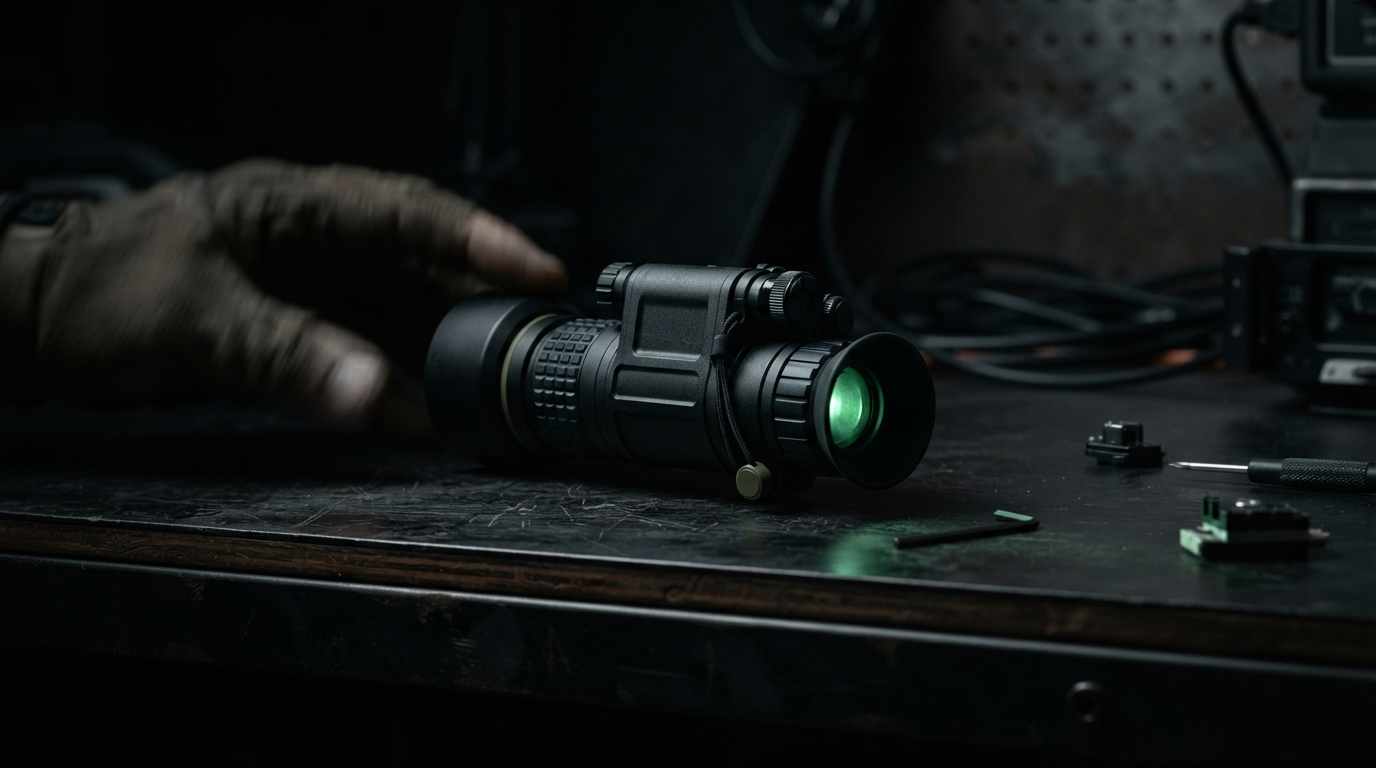
What is night vision?
In this library, night vision primarily refers to systems that use image intensification to make very low levels of available light useful to the human eye. Instead of detecting heat, an image-intensified system amplifies incoming light and presents a visible image of the scene.
That makes night vision fundamentally different from thermal imaging. Thermal systems visualize differences in thermal energy rather than simply amplifying the visible scene.
Night vision amplifies light. Thermal visualizes heat differences.
How image intensification works.
- 1AVAILABLE LIGHT
Very low levels of light enter through the objective lens.
- 2IMAGE INTENSIFIER
Incoming light is converted and amplified inside the image intensifier.
- 3AMPLIFIED IMAGE
The intensified signal forms a visible image on the output screen.
- 4EYEPIECE
The eyepiece presents that image to the viewer.
The internal physics are more complicated than this simplified diagram, but the sequence explains the central idea: image-intensified night vision takes a scene that is too dark for comfortable unaided viewing and makes more of the existing visual information usable.
A night vision device is more than its tube.
Tube specifications matter, but the completed device also depends on optics, housing design, controls, power, mechanical construction, adjustment range, ergonomics, and how those pieces work together.
Two devices using similar image intensifiers can still provide noticeably different ownership and viewing experiences.
The component responsible for converting and amplifying very low levels of incoming light.
Collect and focus incoming light before it reaches the image-intensification system.
Presents the intensified image to the viewer and contributes to the overall viewing experience.
Provides the physical structure, adjustment mechanisms, controls, sealing, and mounting interfaces of the complete device.
May include power, gain control, focus, adjustments, indicators, and other device-specific functions.
Battery choice, runtime, external-power capability, and environmental behavior all affect the complete system.
The tube matters. So does everything around it.
Learn the fundamentals in order.
Night vision becomes easier to understand when the subject is approached in layers. Start with how the system creates an image, then learn the specifications, device formats, and buying considerations.
- 01→
How Night Vision Works
Understand image intensification before comparing products or specification sheets.
- 02→
Night Vision Specifications Explained
Learn what resolution, SNR, EBI, halo, gain, and FOM are actually describing.
- 03→
Monocular vs. Binocular Night Vision
Compare device formats based on cost, weight, complexity, and viewing experience rather than assuming one is universally superior.
- 04→
Thermal vs. Night Vision
Understand why two technologies used after dark can reveal completely different information.
- 05→
Buying Your First Night Vision Device
Turn technical knowledge into a rational purchasing framework.
- 06→
How NSG Evaluates Night Vision
Learn how specifications, usability, observations, environment, and disclosure fit into NSG's review process.
The spec sheet is useful. It is not the whole story.
Specification sheets provide measurable information about an image intensifier, but each value describes a different part of performance. A single large number cannot tell you everything about what the image will look like in every environment.
Resolution
Resolution describes a system's ability to distinguish fine detail under specified test conditions.
Why it matters
Higher detail capability can be useful, but resolution alone does not describe how clean or useful an image remains as lighting conditions become more difficult.
Signal-to-Noise Ratio
Signal-to-noise ratio, commonly shortened to SNR, describes useful image signal relative to image noise.
Why it matters
Image noise becomes increasingly noticeable as the scene becomes darker, making SNR an important part of understanding low-light image quality.
EBI
EBI is associated with background output generated by the image intensifier when very little useful light is present.
Why it matters
It is one of several characteristics that can influence how useful the image remains in extremely dark conditions.
Halo
Bright points of light can produce a visible bright region around the source in an intensified image. Halo measurements are used to characterize that behavior under standardized conditions.
Why it matters
Light sources within a scene can affect surrounding image detail and overall viewing comfort.
Gain
Gain describes amplification within the image-intensification system.
Why it matters
More amplification does not automatically equal a better image. Brightness, noise, available light, and device controls all interact.
FOM
Figure of Merit is a commonly referenced performance figure derived from multiple tube characteristics.
Why it matters
FOM can provide useful comparison context, but it does not describe every characteristic that influences image quality or the complete device.
Autogating
Autogating is a tube-control technology used to help an image intensifier operate across changing or higher-light conditions.
Why it matters
Real environments rarely maintain one perfectly stable light level.
Manual Gain
Manual gain allows the user to adjust image amplification or displayed brightness behavior on compatible systems.
Why it matters
User control and automatic tube behavior are different concepts and should not be treated as interchangeable.
Stop shopping by one number.
It is tempting to sort expensive equipment by the largest specification on the page. Real evaluation is less convenient. Resolution, image noise, background behavior, halo, gain, optics, cosmetics, controls, and environmental conditions all contribute to what a device actually presents.
A high number can be meaningful without being the whole answer.
A specification should answer a question—not replace one.
Real equipment decisions require context. A device is a system made from an intensifier, optics, housing, controls, power, and the environment in which it is used.
Green vs. white phosphor.
The color of the displayed image is one of the most obvious differences between night vision systems, but phosphor color should not be confused with overall image-intensifier performance.
Devices should still be evaluated using their complete specifications, optics, housing, controls, and intended use.
Produces the familiar green presentation traditionally associated with image-intensified night vision.
Produces a more neutral monochrome-style image presentation.
Neither phosphor is universally better. Image quality depends on the complete tube and device.
One tube or two?
Monocular and binocular systems differ in cost, weight, system complexity, packaging, and viewing experience. Neither format automatically wins every use case.
Monocular
- One intensified image channel
- Simpler system possibilities
- Lower total equipment count
- Often lower entry cost than two-channel systems
- Lower weight potential
- Different viewing experience
Monocular systems remain useful because they can provide substantial capability without requiring two complete image channels.
Binocular
- Two intensified image channels
- Different viewing experience
- Typically higher equipment cost
- Increased system complexity
- Additional components and adjustment requirements
- Potentially greater total weight depending on design
Two-channel systems offer a different viewing experience but introduce additional cost and hardware.
Similar terms can describe different jobs.
Manual gain and autogating are frequently mentioned together even though they address different parts of how an image-intensification system behaves.
Provides user adjustment over amplification or displayed image behavior on compatible devices.
Automatically manages tube operation across changing lighting conditions.
One is a user control. The other is part of how the intensifier manages light.
The tube can only show what the optics give it.
Objective lenses, eyepieces, optical alignment, focus range, field of view, distortion, transmission, and mechanical adjustment all influence the completed device.
Two devices using similar image intensifiers can still provide different viewing experiences because the optical system surrounding the tube matters.
Objective Lens
The front optical assembly that collects and focuses incoming light toward the intensifier.
Eyepiece
Presents the intensified image to the viewer and influences perceived image quality.
Focus
Adjusts the optical path so the image is sharp for the viewer's eye and the scene distance.
Field of View
Describes how much of the scene is visible through the device at one time.
Optical Transmission
How effectively the optical system passes available light through to the intensifier.
Distortion
How faithfully the optical system preserves straight lines and geometry across the image.
Field of view describes how much of the scene is visible through the device at one time. It should be considered alongside image quality, optical design, magnification, and device size rather than treated in isolation.
Runtime is part of performance.
A night vision device still depends on a power system. Battery format, runtime, storage, temperature, controls, and compatibility with external power can all affect ownership.
Battery Format
Common formats, availability, and the tradeoffs of each power choice.
Runtime
How long a device operates on a given power source under normal use.
Cold-Weather Behavior
How batteries and power systems perform as temperature drops.
Battery Storage
Storage practices that protect both batteries and the device over time.
External Power
Compatibility with external power sources for extended operation.
Power Controls
How the device manages power state, indicators, and conservation.
The environment changes the image.
Available light, cloud cover, nearby artificial lighting, weather, reflective surfaces, vegetation, and other environmental conditions can change what an image-intensified system presents.
That is why specifications should be paired with real-world observations when equipment is reviewed.
Moonlight, starlight, artificial light, and other illumination affect how much useful information enters the system.
Lights inside the scene can affect local contrast and image presentation.
Atmospheric and weather conditions can influence visibility and scene detail.
Vegetation, structures, reflective surfaces, and terrain can change what the user sees.
Start with the problem, not the product.
Before comparing brands or chasing specifications, define what you need the device to accomplish, what performance actually matters, what tradeoffs you will accept, and what the complete ownership cost looks like.
- 01
Define the use
Observation, navigation, wildlife viewing, property use, recreation, and general low-light capability can emphasize different characteristics.
- 02
Set the complete budget
Budget for the complete ownership system rather than only the primary device. Accessories, power, storage, service, and support may affect total cost.
- 03
Choose the device format
Understand the differences between monocular and binocular systems before assuming more hardware automatically means a better fit.
- 04
Read the specifications
Know what the major tube and system specifications describe before using them to compare products.
- 05
Evaluate the complete device
Consider optics, housing, controls, power, ergonomics, build quality, warranty, support, and serviceability.
- 06
Understand the seller
Expensive technical equipment should come with clear condition information, transparent specifications, realistic support, and understandable warranty or service terms.
- 07
Compare alternatives
Make sure night vision solves your actual problem better than a less expensive device, different format, thermal system, illumination solution, or other technology.
Reviews should answer a decision.
A useful review should explain more than whether the reviewer liked the product. It should describe what was tested, what the device does well, where the limitations are, what competes with it, and who should actually spend money on it.
Testing and reviews are being added as equipment becomes available.
Until then, the Night Vision library focuses on the technology, evaluation criteria, and buying frameworks that future NSG reviews will use.
Represent a manufacturer or brand? NSG accepts appropriate products and loaner equipment for independent evaluation. Supplying equipment does not guarantee favorable coverage.
Some decisions make more sense side by side.
- →
Thermal vs. Night Vision
Compare two technologies that reveal fundamentally different information after dark.
- →
Monocular vs. Binocular Night Vision
Compare cost, weight, complexity, and device architecture.
- →
Green vs. White Phosphor
Understand image presentation without treating phosphor color as a complete performance ranking.
- →
Digital vs. Image-Intensified Night Vision
Understand the differences in how different systems form and present low-light images.
- →
Higher-Spec vs. Lower-Spec Tubes
Explore what actually changes as tube performance specifications increase.
A spec sheet is the beginning of a review.
When NSG physically evaluates night vision equipment, the goal is to combine documented specifications with repeatable observations, clear conditions, and transparent limitations. Testing should help readers understand what changed—not simply create a score.
Documentation
Record known specifications, model details, configuration, source information, and manufacturer-provided documentation.
Physical inspection
Evaluate controls, construction, adjustments, interfaces, battery compartment, optics, and overall device condition.
Controls & usability
Document how the device operates, focuses, adjusts, powers on, and handles normal interaction.
Image observations
Observe image characteristics under disclosed lighting and environmental conditions rather than judging from a single photograph.
Power & runtime
Document battery format, controls, and runtime observations where relevant and practical.
Appropriate comparisons
Compare equipment against realistic alternatives where equivalent equipment is available.
Disclosure
State whether equipment was purchased, supplied, loaned, discounted, or otherwise provided for review.
A free product does not buy a positive review.
Terms worth knowing.
- AUTOGATING
- A control technology used in some image intensifiers to manage changing light conditions.
- EBI
- A specification associated with background output from an image intensifier in very dark conditions.
- FOM
- A calculated performance figure derived from multiple tube characteristics.
- GAIN
- Amplification occurring within the image-intensification system.
- HALO
- A bright region that can appear around a strong point light source in an intensified image.
- IMAGE INTENSIFIER
- The component that converts and amplifies very low levels of incoming light into a visible image.
- LP/MM
- Line pairs per millimeter, a unit commonly used when discussing resolution.
- MANUAL GAIN
- User-adjustable control over image amplification or brightness behavior on compatible systems.
- MICROCHANNEL PLATE
- A component used within many image intensifiers as part of the electron-amplification process.
- OBJECTIVE LENS
- The front optical assembly responsible for collecting and focusing incoming light.
- PHOTOCATHODE
- The component within an image intensifier that converts incoming photons into electrons.
- PHOSPHOR
- The output material used to convert the amplified electron signal back into a visible image.
- RESOLUTION
- A measure used to describe the ability to distinguish fine image detail.
- SNR
- Signal-to-noise ratio, describing useful image signal relative to image noise.
- WHITE PHOSPHOR
- A monochrome-style image presentation used in some image-intensified systems.
Night vision questions people actually ask.
- Is night vision the same as thermal imaging?
- No. Image-intensified night vision amplifies available light, while thermal imaging visualizes differences in thermal energy. They provide different information and have different strengths and limitations.
- Does a higher FOM automatically mean better night vision?
- Not by itself. FOM can be useful comparison information, but it does not describe every tube characteristic, the optical system, device design, or how the image behaves in every environment.
- Is white phosphor automatically better than green phosphor?
- No. Phosphor color affects image presentation, but it does not independently determine overall tube or device performance.
- Does image-intensified night vision work in complete darkness?
- Image-intensified systems require useful incoming light. In extremely dark environments, compatible supplemental illumination may be needed. Thermal imaging operates using a different physical principle.
- Is a binocular system always better than a monocular?
- No. The formats differ in cost, weight, complexity, hardware, and viewing experience. The better choice depends on the user's priorities and budget.
- What should a beginner learn before buying night vision?
- Start with how image intensification works, then learn the major specifications, device formats, and the differences between night vision and thermal before comparing specific products.
Related low-light topics.
Understand how thermal systems create images from temperature differences.
Explore→IlluminationLearn how visible and infrared illumination interact with low-light equipment.
Explore→Low-Light OpticsExplore the lenses, field of view, transmission, and optical systems surrounding imaging technology.
Explore→Power & BatteriesUnderstand runtime, battery formats, external power, and storage.
Explore→Low LightReturn to the master Low Light library.
Explore→Expensive equipment deserves patient research.
Get new night vision explainers, product-testing notes, reviews, field observations, and comparison guides through NSG Field Notes.